Updated July 2026 · 18-min read
There’s a moment in every love story that changes everything. For Blake Lively, that moment came with a 12-carat pink diamond she never saw coming – and honestly, neither did the engagement ring industry.
I’ve spent years studying celebrity engagement rings, and I can tell you this without hesitation: no single ring in the last two decades has reshaped what brides want, what jewelers recommend, and what “dream ring” even means quite like Blake Lively’s. Not Meghan Markle’s. Not Kim Kardashian’s. Blake’s.
But here’s what gets lost in all the carat talk and price tag gossip – this ring is really a love story wearing a diamond. And once you understand the full picture, you’ll never look at it the same way again.
Before the Ring, There Was a Really Awkward Double Date
You can’t appreciate what this ring means without knowing how Blake and Ryan got here. And trust me, the origin story is better than any rom-com script.
They met on the set of Green Lantern back in 2010. Played love interests on screen. Off screen? Completely unavailable. Ryan was married to Scarlett Johansson. Blake was dating Penn Badgley from Gossip Girl. Zero romantic sparks.
Fast forward to 2011. Both relationships had ended. Both were single. And then came the double date that changed everything.
Ryan told the story himself – they went out as a foursome, each with someone else. But the connection between him and Blake was so electric, so immediate, that the two other people at the table basically became invisible. He later joked on the SmartLess podcast about how he offered to ride a train with her to Boston, shamelessly trying to impress her the entire way.
By October 2011, tabloids confirmed they were a couple. By September 9, 2012, they were married in a private ceremony at Boone Hall Plantation in South Carolina. Florence Welch sang. Blake wore Marchesa. And somewhere between that train ride and the wedding day, Ryan Reynolds pulled off one of the most impressive proposals in Hollywood history – one that Blake knew absolutely nothing about until it happened.
The exact date? The exact location? They’ve never told anyone. That’s very on-brand for a couple who’ve made privacy an art form. But what we do know is what was on her finger when she said yes.
And oh, what a ring it was.
Let’s Get the Stats Out of the Way
I know some of you scrolled straight here. No judgment – I’d do the same. Here’s the quick breakdown before we get into the juicy details:
The stone: 12-carat oval-cut natural pink diamond, internally flawless
The setting: Solitaire on a delicate pavé band with a hidden halo underneath
The metal: 18K rose gold
The designer: Lorraine Schwartz (more on her shortly – she’s fascinating)
The price tag: Around $2 million, though some gemologists say $1.8M to $2.5M depending on how you grade it
Ring size: Likely a 6 or 7, based on paparazzi photos
The surprise factor: 100%. Blake had zero input on the design.
Now. Let’s talk about why each of those details matters way more than you think.
Lorraine Schwartz Isn’t Just a Jeweler. She’s Hollywood’s Best-Kept Secret.
If you’re not deep into the jewelry world, you might not recognize the name Lorraine Schwartz. But I promise you’ve seen her work – probably hundreds of times without realizing it.
Remember Beyoncé’s titanium glove in the “Single Ladies” video? Lorraine made that. Angelina Jolie’s jaw-dropping emerald earrings at the 2009 Oscars – the ones worth $2.5 million that literally stopped people mid-sentence on the red carpet? Lorraine. Kim Kardashian’s 15-carat cushion-cut engagement ring from Kanye? Lorraine again. Beyoncé even name-drops her in two songs. That’s the level of trust we’re talking about.
But here’s what makes Lorraine different from, say, Tiffany or Cartier or any of the big heritage houses. She doesn’t operate like a brand. She operates like a friend.
She comes from a third-generation family of New York diamond dealers. Took over the business in 1989 after losing her mother to cancer. Renamed it, reimagined the whole approach, and started creating pieces that felt personal and alive rather than stuffy and traditional. Her very first celebrity client? David Bowie. He walked into her showroom in 1994 looking for a diamond for Iman, and she was so nervous she literally tripped on a chair and fell into him. She ended up making Iman’s engagement ring – a gorgeous canary yellow diamond – and never looked back.
What matters here is that Blake Lively doesn’t just hire Lorraine Schwartz. She considers her a dear friend. Blake has said so publicly. So when Ryan Reynolds decided to propose, he didn’t go ring shopping at some boutique. He went to the one person who knew Blake’s taste intimately, who understood what would make her cry happy tears, and who had the skill to turn that understanding into 12 carats of perfection.
As Lorraine herself has put it – the most important piece of jewelry she can make is an engagement ring. The stones have to tell a story.
This one tells a hell of a story.
That Diamond, Though. Let’s Really Talk About It.
Okay, I need you to sit with this for a second. Because a 12-carat pink diamond isn’t just “a big fancy stone.” It’s something the planet barely ever produces.
What Makes a Diamond Pink (and Why Nobody Fully Understands It)
Most colored diamonds get their hue from a specific chemical element. Blue diamonds? Boron. Yellow? Nitrogen. Straightforward enough.
Pink diamonds? Scientists genuinely aren’t 100% sure.
The best theory we have is something called “plastic deformation.” Basically, over a billion years ago, deep inside the earth, certain diamonds experienced such extreme pressure that their crystal lattice – the internal molecular grid that gives a diamond its structure – got physically distorted. Twisted. Warped. And that warping changed the way the stone absorbs and reflects light, producing a pink color that ranges from the faintest blush to a deep, saturated rose.
Nobody engineered this. Nobody planned it. The earth just… did something extraordinary, once, in a very specific place, under conditions we still can’t fully replicate or predict. That’s wild, if you stop and think about it.
And Then the Only Major Source Shut Down. Permanently.
Here’s where Blake’s ring goes from “gorgeous” to “practically irreplaceable.”
For 37 years, a single mine in the remote Kimberley region of Western Australia – the Argyle Mine, operated by Rio Tinto – produced somewhere around 90 to 95 percent of the world’s pink diamonds. Let that sink in. Nearly all the pink diamonds that exist in jewelry stores, auction houses, and private collections around the world came from one spot in the Australian outback.
Even at its peak, pink diamonds made up less than one percent of everything the mine produced. Of that sliver, only 5% were gem-quality. One in every 10,000 diamonds pulled out of Argyle was pink and actually suitable for fine jewelry. Rarity within rarity within rarity.
On November 3, 2020, the Argyle Mine closed for good. Not temporarily. Not for restructuring. The geological reserves were exhausted. The diamonds were gone.
And the market responded exactly the way you’d expect.
In the first year after closure, fancy pink diamond prices jumped roughly 23%. The more intense pinks? Up 29%. Fancy vivid pinks – the rarest tier – surged 39%. Looking at longer timeframes, Argyle pinks have appreciated over 500% in the past two decades, outperforming every major equity market on the planet.
Nobody has found another comparable source. Geologists have been looking for over 30 years. Even if someone struck pink tomorrow, experts say it would take 10 to 15 years to bring a new mine into commercial production. The supply isn’t declining. It has stopped. Industry analysts are calling it “unengineerable scarcity” – a situation where no amount of money, technology, or exploration can reverse what’s happened.
So what does that mean for Blake Lively’s ring?
When Ryan Reynolds bought that 12-carat internally flawless pink diamond – presumably in 2011 – it was already extraordinarily rare and worth around $2 million. Today? After the Argyle closure and the relentless upward pressure on pink diamond values? That same stone would almost certainly command significantly more. Some in the industry believe the ring’s current value has climbed well past its original price tag.
Blake Lively isn’t just wearing a beautiful ring. She’s wearing a geological artifact that the earth may never produce again.
Breaking Down Blake’s Specific Stone
Let me walk you through what makes her particular diamond so exceptional, because each characteristic compounds the rarity.
12 carats. Most engagement diamonds sit between one and two carats. Blake’s stone is six to twelve times larger than the average. In the world of pink diamonds, where large specimens are vanishingly rare to begin with, 12 carats is staggering.
Oval cut. This is what gives the stone its elongated, elegant shape. The oval maximizes the diamond’s surface area (so it looks even bigger on the finger) and distributes the pink color evenly across the face. It’s also incredibly flattering to the hand – the tapered ends create a slimming visual effect that round cuts don’t offer.
Internally flawless. Under 10x magnification – the industry standard for grading – a trained gemologist cannot find a single inclusion or imperfection in this stone. Flawless diamonds of any color are rare. A flawless pink diamond this size? Most jewelers will go their entire career without handling one.
Natural light pink color. Not treated. Not enhanced. Not irradiated. The blush tone is the stone’s natural color, produced by geological forces over a billion years ago.
Put all four together – size, cut, clarity, color – and you’re looking at a stone that would make museum curators weep.
The Setting Is Where the Genius Lives
I think most articles about this ring spend too much time on the diamond and not enough on the setting. Because the design choices Ryan and Lorraine made around that stone are what elevate it from spectacular to iconic.
Rose Gold Was a Gutsy Call in 2012
It’s easy to forget, but rose gold wasn’t the mainstream darling it is today when this ring was created. Most high-end engagement rings in 2012 were platinum or white gold. Rose gold was considered a vintage or “alternative” choice – lovely, sure, but not what you’d expect on a $2 million celebrity ring.
Choosing 18K rose gold was a stroke of genius. The copper alloy in the metal gives it that warm, pinkish warmth that echoes and amplifies the diamond’s blush tone. Instead of a cool white setting that would contrast against the pink stone, the rose gold creates this beautiful visual continuity – the entire ring seems to glow with the same soft, romantic warmth. Stone and metal in perfect conversation.
The Pavé Band: Supporting, Not Competing
“Pavé” means “paved” in French, and that’s literally what it looks like – the band is paved with two rows of tiny round diamonds set flush into the rose gold. The effect is a continuous shimmer that runs down both sides of the center stone, adding brilliance without creating visual noise.
This is restraint in action. With a 12-carat center stone already making a massive statement, the pavé band provides sparkle that supports rather than competes. The diamonds are deliberately small and set low. The band stays slim. Everything defers to the main event.
The Hidden Halo: A Love Letter You Can Only See From the Side
This is my favorite part of the whole ring, and most people don’t even know it exists.
Underneath the center diamond – invisible when you’re looking at the ring from above – sits a ring of tiny diamonds called a “hidden halo.” You can only see it from certain angles, when light catches the underside of the setting and suddenly there’s this unexpected burst of sparkle.
I love this detail because it feels like a metaphor for the relationship itself. It’s not showy. It’s not performative. It’s something intimate, something private, something the wearer discovers gradually in quiet, everyday moments – reaching for a coffee mug, tucking a strand of hair behind her ear, turning her hand in the sunlight while waiting at a stoplight.
It’s the kind of detail that makes you think whoever designed this ring really understood the woman who would wear it.
What Blake Has Actually Said About the Ring
Blake Lively is notoriously private. She doesn’t do ring selfies on Instagram. She doesn’t show it off in magazine spreads. But on the rare occasions she’s spoken about it, her words are worth paying attention to.
In an interview with British Vogue, she called it her most treasured possession – made by her dear friend Lorraine Schwartz, because of the love and meaning it symbolizes. She also confirmed, simply and sweetly, that she had no hand in its design, and that she married a gentleman.
Stop and sit with that for a moment.
This is a woman who has worn some of the most extraordinary jewelry in existence. She has walked red carpets dripping in diamonds worth more than most people’s houses. And when asked about her most treasured possession, she doesn’t name a necklace or a pair of earrings or any of the spectacular pieces she’s borrowed from the world’s greatest jewelers.
She names the ring. And not because of the 12 carats. Because of what it means.
There’s also this fun industry detail – Ji Song, who runs Engage Studio, has publicly said that Blake Lively’s ring is the most requested celebrity design from their customers. His theory on why? It has so many delicate features that work together harmoniously. People aren’t just drawn to the size. They’re drawn to the thoughtfulness.
The Wedding Bands Deserve Their Own Moment
One thing that throws people off in photos is that Blake’s ring sometimes looks different depending on the event. That’s because she stacks it with her wedding band, and the two were designed by Lorraine Schwartz to sit together as a matched pair.
The wedding band features its own diamond accents that complement the engagement ring’s pavé design, and it sits flush against the ring with zero gap. When worn together, they almost look like one continuous, unified piece – two rings that complete each other, which, let’s be honest, is a pretty beautiful metaphor for marriage itself.
This “flush-stack” approach to wedding bands has become hugely popular in recent years, and Blake’s set is one of the most cited inspirations for it.
How This One Ring Changed an Entire Industry
I don’t think it’s hyperbole to say that Blake Lively’s engagement ring shifted the trajectory of the jewelry market. Here’s what changed – and why the changes stuck.
Oval Diamonds Went From “Interesting Choice” to “Default Choice”
Before Blake’s ring surfaced, the oval cut was a fringe player. Round brilliants dominated. Princess cuts had their moment. Ovals were considered vaguely vintage, vaguely unconventional – pretty, but not the mainstream pick.
After Blake? The oval exploded. Industry data shows oval-cut diamonds went from roughly 2% of engagement ring purchases to over 20%. By the mid-2020s, it became the most popular non-round shape in America. Jewelers I’ve spoken to point directly to Blake Lively as the tipping point. One told me, flat out, that requests for oval-cut engagement rings doubled within a year of her ring going public.
Rose Gold Stopped Being “Alternative”
Rose gold engagement rings existed before Blake Lively. But they were niche – the pick for people who wanted something “different.” Her ring proved that rose gold could anchor the most expensive, most high-profile engagement ring in the room. Suddenly, it wasn’t alternative. It was aspirational. The rose gold trend that dominated the mid-to-late 2010s traces its roots directly back to this ring.
Colored Diamonds Got Permission to Be the Main Event
This might be the most lasting impact. Before Blake, the engagement ring conversation was essentially: white diamond, big as you can afford, brilliant cut, platinum or white gold. Color was for cocktail rings and fashion pieces, not the ring you’d wear every day for the rest of your life.
Blake’s pink diamond shattered that assumption at the highest possible level. And it gave millions of brides permission to think differently – to consider pink sapphires, morganite, champagne diamonds, grey diamonds, even colored moissanite as legitimate center stone options. Not as “budget alternatives.” As genuine choices that reflect personal taste and romantic meaning.
That shift in mindset – from “what’s expected” to “what feels like me” – is Blake Lively’s most enduring contribution to engagement ring culture. And I genuinely don’t think we’d be where we are today without her ring paving the way.
You Don’t Need $2 Million to Capture This Look. Here’s How.
Let’s be real – almost nobody is dropping $2 million on a ring. The beautiful thing about Blake’s design is that what makes it special isn’t the price tag. It’s the harmony between three specific elements, and you can recreate that harmony at virtually any budget.
The Three Ingredients You Actually Need
An oval-cut center stone. This is non-negotiable if you’re going for the Blake look. The elongated shape is the signature.
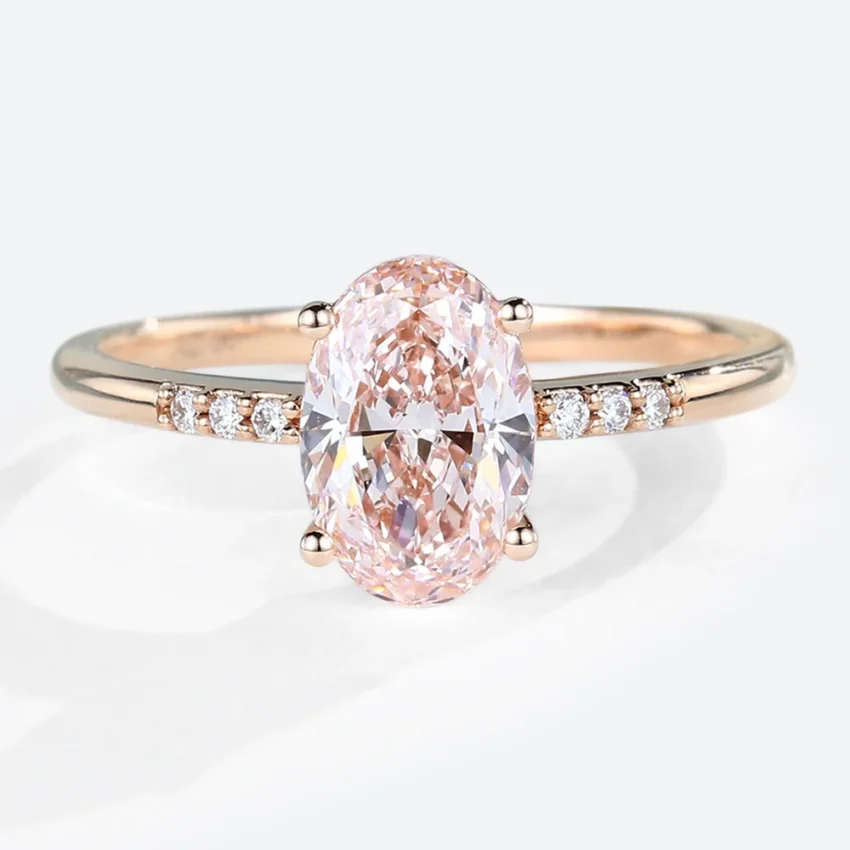
Pink or warm blush tones. Either from the stone itself (morganite, pink sapphire, lab-grown pink diamond) or from the rosy reflection a near-colorless stone picks up when set in rose gold.
A rose gold pavé band. Thin, delicate, two rows of tiny stones. This is the frame that ties it all together.
What You Could Actually Spend
Around $1,500 to $2,000: Go with a morganite center stone in rose gold. Morganite is a naturally pink gemstone from the beryl family (same family as emeralds, fun fact), and the soft peach-pink color is a gorgeous nod to Blake’s blush diamond. It’s not as hard as diamond, so it needs a bit more care, but the look is stunning and the price is approachable.
$3,000 to $6,000: A lab-grown pink diamond or a high-quality pink sapphire on a rose gold pavé setting gets you much closer to the original. Lab-grown diamonds are chemically and physically identical to mined diamonds – same carbon crystal structure, same hardness, same brilliance. The only difference is their origin, and they come at a fraction of the price.
$7,000 to $15,000: A one to two carat lab-grown pink diamond with a hidden halo and double-row pavé band in 18K rose gold starts to replicate not just the aesthetic but the structural design details – the things that make Blake’s ring feel different from every other oval solitaire out there.
$15,000 and up: You’re in natural pink diamond territory. The stone will be smaller than Blake’s 12 carats (obviously), but a natural pink diamond in a custom rose gold pavé setting is, in every meaningful way, a close sibling to the original.
One piece of advice I always give people chasing this look: resist the urge to over-decorate. The power of Blake’s ring is in its restraint. The setting is deliberately understated so the stone can breathe. Don’t add side stones. Don’t do a cathedral setting with filigree. Keep it clean. Let the stone-metal harmony do the talking.
Taking Care of a Ring Like This
Whether you’re wearing a $2 million pink diamond or a $2,000 morganite alternative, these rings need specific care. The rose gold and pavé setting are both more delicate than they look.
Clean gently at home. Warm water, a drop of mild dish soap, a soft baby toothbrush. That’s all you need. Skip the ultrasonic cleaner – the vibrations can gradually loosen pavé stones over time, and you really don’t want to lose one of those tiny diamonds without noticing.
Baby the rose gold. Copper makes rose gold warmer in color but also slightly softer than white gold or platinum. Take the ring off for workouts, gardening, anything involving impact or rough surfaces. A scratch on rose gold is more visible than on harder metals.
Get the pavé checked regularly. Every six to twelve months, have a jeweler look at those tiny stones under magnification. Pavé settings are gorgeous, but the micro-prongs holding each stone can wear down with daily life. Catching a loose stone early saves you from losing it entirely.
Insure it. This goes for any ring you’d be heartbroken to lose, whether it cost $2,000 or $2 million. Get it appraised, get it insured, and update the appraisal periodically – especially if your center stone is a pink diamond, because those values have been climbing sharply since 2020 and your coverage needs to keep pace.
Your Questions, Answered Honestly
What’s Blake Lively’s engagement ring actually worth today?
It was estimated at approximately $2 million when Ryan bought it, with some experts placing it between $1.8M and $2.5M. But here’s the thing – pink diamond values have surged dramatically since the Argyle Mine closure in 2020. Given the 12-carat size, internally flawless clarity, and natural pink color, the current market value has almost certainly increased well beyond the original price. Some industry insiders believe it could be worth considerably more today.
How big is the diamond?
The center stone is estimated at 12 carats. To put that in perspective, the average engagement diamond in the U.S. is around one carat. Blake’s stone is roughly twelve times that.
Did Blake pick out her own ring?
Nope. She’s been very clear about this. She told British Vogue she had no input on the design and married a gentleman. Ryan worked with Lorraine Schwartz behind the scenes to create it as a complete surprise.
Why are pink diamonds so insanely expensive?
Three reasons stacked on top of each other. First, the geological conditions that create pink coloration in diamonds are extraordinarily rare and still not fully understood. Second, the Argyle Mine in Australia – which supplied 90-95% of the world’s pink diamonds – closed permanently in 2020, cutting off nearly all new supply. Third, demand hasn’t dropped. If anything, it’s intensified. When supply essentially hits zero and demand keeps growing, prices have only one direction to go.
What’s a hidden halo?
It’s a circle of small diamonds tucked underneath the center stone. You can’t see it looking at the ring from above – it reveals itself from the side or when light catches it at certain angles. It adds unexpected sparkle and makes the center stone appear to float. Blake’s ring has one, and it’s one of the most charming design touches I’ve come across.
Can I actually get something similar without spending a fortune?
Yes, genuinely. The look isn’t about the price – it’s about the design language. An oval-cut morganite or lab-grown pink diamond on a rose gold pavé band captures the essence of Blake’s ring starting around $1,500. The key elements are the shape, the color warmth, and the delicate band. Nail those three, and you’ll get compliments from people who recognize exactly what inspired it.
Is this the most expensive celebrity ring ever?
No – rings belonging to Beyoncé, Mariah Carey, and Elizabeth Taylor have all been valued higher. But Blake’s ring is arguably the most influential. It changed what an entire generation wanted from their engagement ring, and that cultural impact is worth more than any price tag.
What metal is the band?
18-karat rose gold. The copper alloy gives it that warm, pinkish tone that mirrors and amplifies the pink diamond. It’s one of those “obvious in hindsight” choices that was actually quite bold for a major celebrity ring in 2012.
Why We’re Still Talking About This Ring After All These Years
I think the reason this ring has endured in the cultural imagination – long after other celebrity rings have faded into “oh, that was nice” territory – comes down to something you can’t engineer with carats or clarity grades.
It’s the story underneath the stone.
Ryan Reynolds didn’t hand his credit card to a jeweler and say “give me the biggest, most expensive thing you’ve got.” He sat down with his fiancée’s close friend, someone who knew Blake’s taste and personality intimately, and together they designed something that was entirely, specifically, uniquely her. He took the creative risk of not asking Blake what she wanted. He trusted his knowledge of the woman he loved and his partnership with someone she trusted.
And Blake? She didn’t need a mood board or a Pinterest folder or a carefully curated list of specifications. She trusted the person giving her the ring. That’s it. That’s the whole thing.
In a cultural moment where engagement rings are often optimized, committee-approved, and designed for the Instagram flat lay before they’re designed for the finger, there’s something deeply refreshing about a ring that was born from instinct, friendship, and the quiet confidence of knowing someone well enough to surprise them perfectly.
The 12 carats are stunning, obviously. The pink diamond is otherworldly. The rose gold is inspired. But what makes this ring truly unforgettable is the simplest thing of all – one person knew another person’s heart well enough to choose exactly the right stone, in exactly the right setting, at exactly the right moment.
You can’t buy that. But if you’re lucky, you can live it.
This article is for informational and educational purposes only. Diamond valuations are estimates based on publicly available expert assessments and are subject to market fluctuation. Nothing here constitutes financial or investment advice.